
All Brands
Dryer Repair Near You — All Brands
Fast, reliable local Dryer repair — certified neighborhood technicians, all brands, same-day available.
Mon–Fri 7am–7pm · Sat 8am–5pm
Manufacturers We Are Trained On













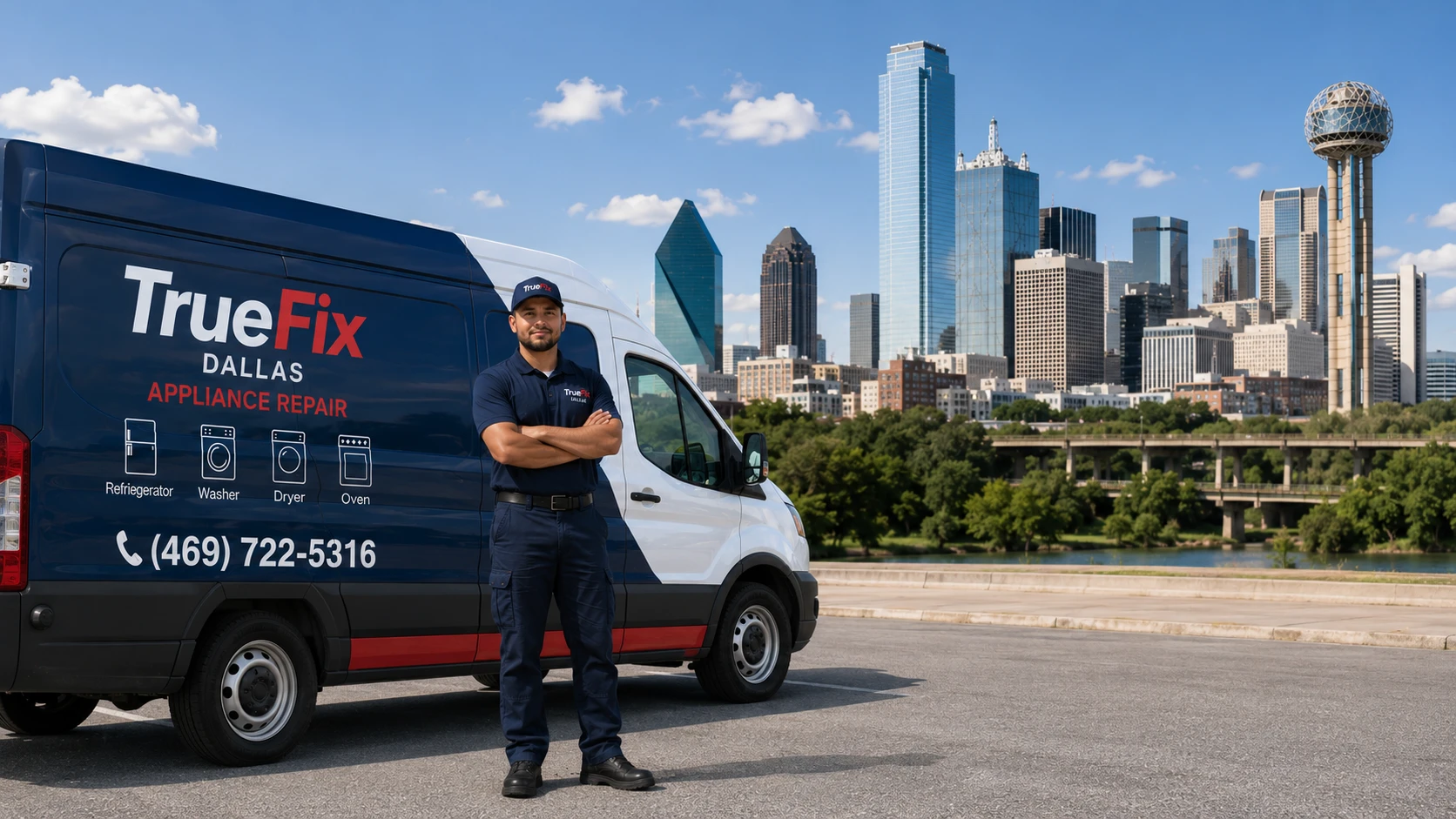
Built for Dallas — Homes, Condos & More
True Fix Dallas offers local Dryer repair near you. Our certified neighborhood technicians diagnose and fix any Dryer problem, from simple issues to complex repairs. We service Samsung, LG, Whirlpool, GE, Maytag, Bosch, KitchenAid, Frigidaire, Sub-Zero, and all other manufacturers. Book your Dryer repair today for same-day service.
How a Call Actually Goes
Related Services
Certified Dallas technicians across every appliance and brand we cover.
How Your Dryer Actually Works
A dryer's job is to move heated air through a tumbling drum of wet laundry and exhaust the moisture-laden air outside the house. Electric dryers generate heat with a resistance heating element; gas dryers use a burner assembly with an igniter that has to glow hot enough to draw sufficient current before a gas valve opens to admit fuel. Both designs share the same supporting cast: a blower wheel that pulls air through the drum and pushes it out the vent, a cycling thermostat that regulates temperature during normal operation, and a thermal fuse - a one-time safety device wired in series with the heating circuit that permanently opens if the dryer overheats, cutting power to the heater as a fire-prevention measure.
That thermal fuse is worth understanding on its own, because it's the single most common reason a dryer stops heating, and it's almost always a symptom rather than the root cause. It blows when airflow through the vent is restricted enough that heat can't escape fast enough - most often from lint accumulation in the vent duct rather than a fault in the dryer itself. Replacing the fuse without clearing the vent restriction that caused it just sets up another failure. Beyond the heat and airflow system, a broken drive belt or worn drum support rollers are the main mechanical failure points, since the belt is a wear item under constant tension and the drum itself is heavy enough to wear the glides that support it over years of use.
Many dryers use a moisture sensor - a pair of metal strips inside the drum that read electrical conductivity through damp fabric - to automatically end the cycle once clothes reach a target dryness level, rather than relying purely on a fixed timer. When that sensor gets coated with dryer sheet residue, which happens gradually with regular use, it can under-read moisture and end cycles too early, or over-read and run needlessly long cycles - a common complaint that isn't a parts failure at all but a simple cleaning fix. On gas dryers, the valve itself typically contains two or three separate solenoid coils that open in sequence, and a single failed coil can prevent ignition even though the igniter itself is glowing and drawing current normally.
What Dallas's Climate and Housing Stock Mean for This Appliance
Dryer vent condition is a genuine fire-safety issue everywhere, but Dallas's housing mix makes it worth calling out specifically. In historic homes downtown and in neighborhoods like Uptown or Bishop Arts, laundry rooms were frequently added well after original construction, which often means long, indirect vent runs with multiple bends to reach an exterior wall - and every extra foot and every 90-degree turn adds resistance that traps lint faster than a short, straight run would. We also still find flexible foil or plastic vent duct in some older installations, both of which restrict airflow more than rigid metal duct and are more prone to sagging and trapping lint at the low points. Newer construction in Plano and similar developments generally has shorter, more direct vent runs, but even a well-designed vent needs periodic cleaning, and it's easy for a newer homeowner to assume a newer house means no maintenance is needed.
Dallas's humidity also affects drying performance in a less dramatic but real way: on muggy days, incoming makeup air carries more moisture, which extends the effective drying time needed to reach the same dryness level and adds duty cycle hours to the heating element or igniter over a season. It's a secondary factor next to vent condition, but it's part of why we see slightly higher heating-element and igniter call volume through the humid summer months.
Multi-family housing - increasingly common in and around downtown Dallas as older buildings convert to apartments and new mixed-use developments go up - sometimes involves shared or long-run vent systems serving multiple units, which raises the stakes on proper vent maintenance considerably, since a restriction doesn't just affect one household's drying time but can represent a larger building-wide airflow and fire-safety concern. We always recommend a professional vent inspection as part of any move into a unit with an unfamiliar vent configuration, particularly in older converted buildings where the original vent routing wasn't necessarily designed with a modern high-capacity dryer in mind.
Common Failure Patterns We See and Repair-vs-Replace Guidance
A blown thermal fuse triggered by restricted venting is the pattern we encounter most often, and any time we replace one, we check and typically recommend clearing the vent run as part of the same visit - replacing the fuse without addressing the airflow restriction just invites a repeat failure or, worse, a heat buildup that the fuse doesn't catch in time. Heating element failure on electric dryers and igniter failure on gas dryers are the next most common calls, usually presenting as a dryer that tumbles and runs but produces no heat. Broken drive belts show up as a dryer that runs but the drum doesn't turn, often with a burning-rubber smell right before failure.
Dryers are mechanically simple enough that most repairs are straightforward and economical - elements, igniters, belts, and fuses are all inexpensive parts relative to a replacement dryer. The one area where replacement starts to make more sense is drum support wear - glides, rollers, or a rear bearing - on a dryer already past the ten- to twelve-year mark, where the labor to access and replace those components can approach a meaningful share of a new unit's cost.
A dryer that produces no heat at all can trace back to several different components that all produce a nearly identical symptom from the homeowner's perspective, which is why we don't guess - a blown thermal fuse, a failed heating element, a tripped high-limit thermostat, and a failed gas valve coil all result in a dryer that tumbles normally but never gets warm, and misdiagnosing which one it is leads to replacing a part that wasn't actually the problem. Systematic continuity testing through the heating circuit in sequence is the only reliable way to isolate the actual failure point rather than guessing based on symptoms alone.
What a Service Visit Involves
We start every dryer call with an airflow check at the exterior vent hood, since restricted venting is both the most common root cause and a genuine safety issue we won't leave unaddressed. From there we run continuity checks on the thermal fuse, cycling thermostat, and heating element, or test the gas valve coils and igniter draw on gas units. If the complaint is noise or a drum that won't turn, we inspect the belt, idler pulley, and drum support points directly.
Our trucks stock heating elements, thermal fuses, cycling thermostats, idler pulleys, belts, and gas igniters for the brands we see most often, which covers the majority of dryer repairs in one visit. Every repair includes our 90-day parts and labor warranty, and we'll always flag a vent condition that needs attention even when it isn't the reason for the call.
Because vent condition is so directly tied to both dryer performance and fire safety, we offer a full vent cleaning as part of many dryer service calls when the airflow test shows restriction, rather than just fixing the immediate symptom and leaving the underlying cause in place. It's a straightforward add-on for us to perform while we're already on site and have the dryer pulled away from the wall, and it meaningfully reduces the odds of a repeat thermal fuse failure in the following months.
Dryer Repair — What We See
These reflect how TrueFix Dallas technicians actually diagnose and repair dryer issues and come from our own job records.
Dryer Repair — Common Questions
The questions our Dallas dispatchers field most often. Can't see yours? Ask us directly — it takes a minute.
Still have questions?
Our Dallas team is ready — same-day service across Dallas County.
We diagnose the fault first, then give you one fixed price covering parts and labour. You approve it before any work starts, and it does not change afterwards. Call (469) 722-5316 to book a diagnosis.
Yes! We offer same-day Dryer repair across the area. Book online or call (469) 722-5316 to confirm your appointment within minutes.
We repair all major brands: Samsung, LG, Whirlpool, GE, Maytag, Bosch, KitchenAid, Frigidaire, Sub-Zero, and all other manufacturers.
If your Dryer is under 10 years old and repair costs less than 50% of replacement cost, repair is almost always the smart choice. Our technician will give you an honest on-site assessment.
Every Dryer repair includes a 90-day parts and labor warranty. We stand behind our work.
Common Dryer Problems We Fix
Faults our Dallas technicians diagnose on dryers most weeks.
- Not Heating
- Drum Not Tumbling
- Takes Too Long to Dry
- Making Loud Noise
- Won't Start
- Dryer Overheating
- Not Drying Clothes
- Shutting Off Early
- Not Getting Hot Enough
- Taking Too Long to Dry
- Thermal Fuse Blown
- Heating Element Burned Out
- Gas Igniter Not Working
- Gas Valve Solenoid Failure
- Flame Sensor / Radiant Sensor Failure
- Blower Wheel Clogged with Lint
- Exhaust Duct Clogged
- Restricted Exhaust Airflow
- Dryer Venting Improperly
- Drive Belt Broken
- Drum Rollers Worn Out
- Drum Glide / Bearing Worn
- Idler Pulley Seized
- Drive Motor Failure
- Making Loud Noise During Operation
- Squealing Noise During Tumble
- Thumping or Banging Noise
- Rattling Noise
- Control Board Failure
- Cycling Thermostat Failure
- High-Limit Thermostat Failure
- Moisture Sensor Failure
- Dryer Door Not Closing Properly
- Door Switch Failure
- Lint Trap / Screen Damaged
- Start Button Not Working
- Dryer Won't Turn On
- Tripping Circuit Breaker
- Burning Smell
- Clothes Shrinking
- Clothes Still Wet After Full Cycle
- Clothes Damp but Warm After Cycle
- Auto-Dry Sensor Not Working
- Timer Not Advancing
- Electric Dryer No Heat — Partial Power
- Gas Smell from Gas Dryer
- Display Panel Not Working
- Buttons Not Responding
- Won't Spin at All
- Stops Mid-Cycle
- Heat Setting Not Changing
- Excessive Energy Use
- Excessive Static on Clothes
- Clothes Heavily Wrinkled
- Steam Function Not Working
- Moisture Sensor Needs Cleaning
- Exhaust Hose Kinked
- Exterior Too Hot to Touch
- Wrinkle-Prevent Tumble Not Working
- Requires Two or More Cycles to Dry
- Error Code on Display
- Low Gas Pressure to Dryer
- Drum Interior Light Not Working
- Door Handle Broken
- Auto-Dry Cycle Runs All Night
- Gas Burner Orifice Clogged
- Lint Fire Hazard in Ductwork
- Timer Advancing Too Slowly
- Three-Prong Outlet / Four-Prong Cord Mismatch
- Knocking at Startup
- Intermittent Squeaking
- Bird or Pest Nest in Dryer Duct
- Cycling Thermostat Stuck Closed
- Gas Valve Solenoid Kit Needed
- Thermal Cutout Needs Resetting
Dryer Brands We Repair
Factory-trained technicians and genuine OEM parts across every major manufacturer.
SamsungLGWhirlpoolGEMaytagBosch KitchenAidFrigidaire
 Sub-Zero
 VikingKenmoreAmanaElectroluxMiele
 Thermador
 Wolf
Wolf Admiral
 AGA
AGA Asko
Asko Atosa
Atosa Avanti
 Bertazzoni
 Blomberg
 Dacor
Dacor DCS
DCS EverestFisher & Paykel
 Gaggenau
 Hobart
 Hoshizaki
 Hotpoint
 Insignia
 JennAir
 Ice-O-Matic
 La Cornue
 Manitowoc
 Maxx Ice
 Perlick
 Roper
Roper Scotsman
 Sharp
Sharp SmegSpeed Queen
 Thor
Thor True
True Turbo Air
 U-Line
 Vulcan
Also serviced
- GE Profile
- Café
- Monogram
- BlueStar
- Liebherr
- Haier
- Hisense
- Panasonic
- Magic Chef
- Marvel
- Summit
- Danby
- NXR
- Beko
- Bertazzoni Professional
- Zephyr
- XO Appliance
- Forno
- ZLINE
- Verona
Related Articles
- Why Your Dryer Takes Forever — And the Simple Fix
- Dryer Not Heating? The 4 Usual Suspects
- Dryer Won't Tumble: Belt, Roller, or Motor?
- Dryer Making a Loud Noise: Squeaks, Thumps & Grinding
- Is Your Dryer Overheating? Safety First
- Burning Smell From the Dryer: Stop and Check This
- Dryer Won't Turn On: Power and Switch Checks