
All Brands
Microwave Repair Near You — All Brands
Fast, reliable local Microwave repair — certified neighborhood technicians, all brands, same-day available.
Mon–Fri 7am–7pm · Sat 8am–5pm
Manufacturers We Are Trained On



















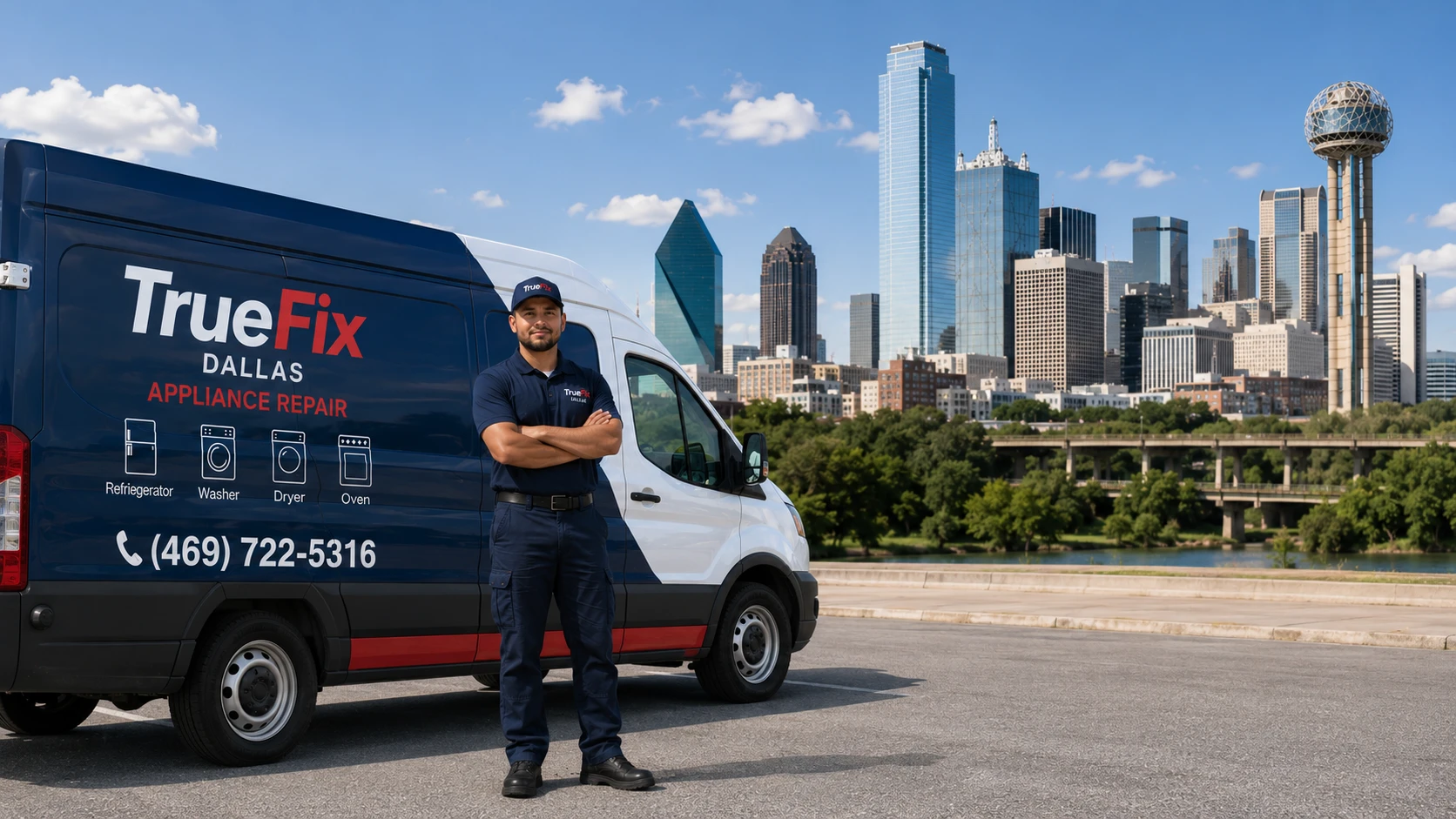
Built for Dallas — Homes, Condos & More
True Fix Dallas offers local Microwave repair near you. Our certified neighborhood technicians diagnose and fix any Microwave problem, from simple issues to complex repairs. We service Samsung, LG, Whirlpool, GE, Maytag, Bosch, KitchenAid, Frigidaire, Sub-Zero, and all other manufacturers. Book your Microwave repair today for same-day service.
How a Call Actually Goes
Related Services
Certified Dallas technicians across every appliance and brand we cover.
How Your Microwave Actually Works
A microwave oven generates cooking energy with a magnetron - a vacuum tube that converts high-voltage electricity into microwave-frequency energy - powered through a high-voltage transformer, capacitor, and diode circuit that steps up and rectifies household current to the several thousand volts the magnetron needs. That energy travels through a waveguide into the cooking cavity, where a turntable motor rotates food for even exposure. None of this is allowed to happen with the door open, which is why microwaves are built with two or three independent door interlock switches wired in a specific safety sequence - if the primary switch fails to disengage properly, a secondary switch is designed to blow a fuse rather than let the magnetron fire with the door ajar.
That interlock system is worth understanding because it's both the most common failure point and a genuine safety system, not just a convenience feature. The switches take mechanical wear every time the door opens and closes - thousands of cycles over a typical microwave's life - and a worn switch can fail in a way that simply stops the unit from running at all, which is actually the safe failure mode by design. The high-voltage capacitor, separately, stores a dangerous charge even after the unit is unplugged, which is why any internal microwave repair requires a proper discharge procedure before a technician touches anything inside the cabinet.
On over-the-range units specifically, the grease filter and exhaust fan assembly are effectively a second appliance built into the same housing, with their own motor and switch separate from the microwave's cooking function entirely - which means a unit that vents poorly or runs loudly on the fan setting can have a perfectly healthy magnetron and cooking function. Inside the cavity, the waveguide cover - a small mica or fiberglass panel that protects the waveguide opening from food splatter - degrades with use and, if left too long, can arc or burn, which sometimes gets mistaken for a more serious internal fault when it's actually one of the least expensive parts in the whole appliance to replace.
What Dallas's Climate and Housing Stock Mean for This Appliance
Over-the-range microwaves that double as a range hood are extremely common in Dallas kitchens, both in newer Plano-area construction, where they're often installed as part of a coordinated cabinet package, and in updated historic-home kitchens where a combination unit saves space compared to a separate hood. That dual role means kitchen grease and moisture pass through and around the unit constantly, which accelerates wear on the door switches and the ventilation fan motor beyond what a purely countertop unit would see, and we see meaningfully more switch and fan-related calls on over-range units as a result.
In some historic downtown homes, cabinet depth or existing electrical rough-in makes an over-range installation impractical, and homeowners use countertop units instead - which sidesteps the ventilation-related wear but means the unit is more exposed to splashes and spills near the countertop. Dallas's humidity is a secondary factor across both installation types, contributing marginally to control panel and keypad degradation over time in units that see heavy daily use.
Microwave drawer units, installed in a lower cabinet rather than over the range or on the counter, have become more common in newer Plano kitchen designs as a way to free up wall space for a full-size wall oven setup - and they introduce their own drawer-slide mechanism and a different door-interlock design than a traditional swing-door microwave, which our technicians diagnose somewhat differently given the different mechanical layout.
Common Failure Patterns We See and Repair-vs-Replace Guidance
Door switch and interlock failure is by far the most common microwave call we see, typically presenting as a unit that won't start, or one that starts and then stops mid-cycle. It's worth noting this directly: because the interlock system is a genuine safety mechanism, a microwave that behaves erratically around door closure - running with the door slightly open, or arcing near the door seal - should be taken out of service and inspected rather than kept in use, since interlock failures are exactly the kind of fault that safety-interlock design exists to catch. Magnetron failure is next most common, usually presenting as a unit that runs normally, spins the turntable, and produces heat from the light and fan but doesn't actually cook food. Turntable motor failure and control panel or keypad failure round out the list.
Door switches, turntable motors, and control panels are all economical repairs and generally worth doing. Magnetron and high-voltage transformer failures are the clearer replace signal - a new magnetron assembly is one of the pricier individual microwave parts, and on a unit already several years old, that cost often approaches or exceeds a comparable new microwave, so we're direct with customers when a call falls into that category rather than running up a repair bill on a component near the end of its practical value.
Keypad and control membrane failure is common enough on heavily used household microwaves that we see it almost as often as door switch issues - certain buttons stop responding, or the display becomes erratic - and it's generally a straightforward, affordable repair rather than a sign of a larger electronic failure, though it can sometimes be caused by moisture intrusion behind the control panel from repeated cleaning with a wet cloth.
Control board failures on higher-end smart or connected microwaves add another wrinkle, since some models tie Wi-Fi connectivity and app-based controls into the same board that manages cooking functions - a board fault on these units can take out both the cooking control and the connected features simultaneously, and replacement boards for smart models tend to run higher than the boards on simpler mechanical-dial units.
What a Service Visit Involves
Any internal microwave work begins with safely discharging the high-voltage capacitor before touching other components - this isn't optional, and it's part of why microwave repair specifically shouldn't be attempted without the right training. From there we test door switch continuity through each stage of door closure, check the fuse, and, for suspected magnetron issues, verify the high-voltage circuit is delivering proper output before condemning the magnetron itself.
We stock door switches, turntable motors, and control boards for the brands we see most often, covering the majority of microwave calls directly. For magnetron or transformer failures, we'll walk through the repair-versus-replace comparison honestly before doing any work. Every repair we do complete carries our 90-day parts and labor warranty.
We explain the high-voltage safety considerations directly to customers when relevant, particularly for older units, since it's part of why microwave repair costs what it does relative to the appliance's original price - the safety procedures involved aren't optional shortcuts we can skip to save time.
If a microwave shows any sign of arcing, sparking, an unusual burning smell, or continues running with the door not fully latched, we recommend unplugging it and having it inspected before further use rather than continuing to run it, since those symptoms point toward exactly the kind of interlock or high-voltage fault that the appliance's safety systems are designed to prevent from operating unchecked. A quick diagnostic visit can usually determine within minutes whether the issue is a simple switch or keypad replacement or something that genuinely warrants replacing the unit, and we'd rather give an honest answer on that call than have a customer keep using a microwave that's showing a warning sign.
Microwave Repair — What We See
These reflect how TrueFix Dallas technicians actually diagnose and repair microwave issues and come from our own job records.
Microwave Repair — Common Questions
The questions our Dallas dispatchers field most often. Can't see yours? Ask us directly — it takes a minute.
Still have questions?
Our Dallas team is ready — same-day service across Dallas County.
We diagnose the fault first, then give you one fixed price covering parts and labour. You approve it before any work starts, and it does not change afterwards. Call (469) 722-5316 to book a diagnosis.
Yes! We offer same-day Microwave repair across the area. Book online or call (469) 722-5316 to confirm your appointment within minutes.
We repair all major brands: Samsung, LG, Whirlpool, GE, Maytag, Bosch, KitchenAid, Frigidaire, Sub-Zero, and all other manufacturers.
If your Microwave is under 10 years old and repair costs less than 50% of replacement cost, repair is almost always the smart choice. Our technician will give you an honest on-site assessment.
Every Microwave repair includes a 90-day parts and labor warranty. We stand behind our work.
Common Microwave Problems We Fix
Faults our Dallas technicians diagnose on microwaves most weeks.
- Microwave Not Heating
- Sparking Inside
- Turntable Not Spinning
- Door Won't Close / Open
- Display Not Working
- Making Loud Noise
- Won't Start
- Sparking Inside Microwave
- Waveguide Cover Burned or Damaged
- Door Switch Failure
- Door Not Closing Properly
- Door Handle Broken
- Turntable Making Grinding Noise
- Control Panel Not Responding
- Runs with Door Open
- Noisy During Operation
- Cooling Fan Not Working
- Burns Food Too Quickly
- Microwave Won't Start
- Interior Light Not Working
- Over-Range Microwave Ventilation Poor
- Grease Filter Clogged
- Charcoal Filter Saturated
- Error Code Displayed
- Intermittent Heating
- Microwave Runs but No Magnetron Power
- Popping or Crackling Noise During Operation
- Overheating and Shutting Off
- Arcing from Metal Rack
- Fan Running After Microwave Is Off
- Some Display Digits Missing
- Sparking from Turntable Tray Area
- Food Heating Unevenly
- Clicking Sounds After Cooking
- Steam or Condensation Inside Microwave
- Burning Plastic Smell from Microwave
- Power Level Selection Not Working
- Inverter Board Failure (Inverter Microwaves)
- Interior Light Flickering
- Microwave Tripping Circuit Breaker
- Water or Moisture in Control Panel
- Error Code Indicating Thermal Fault
- Sensor Cooking Not Working Properly
- Child Lock Won't Disable
- Interior Cavity Coating Peeling
- Ventilation Fan Motor Failure (Over-Range)
- Arcing from Magnetron Antenna
- Runs Only a Few Seconds Then Stops
- Door Won't Latch Closed
- Runs at Wrong Power Level
- Keypad Buttons Sticking
- Vent Damper Stuck Closed or Open
- No Sound / No Beep
- Display Shows Wrong Time After Power Outage
- Grease Fire Risk — Heavy Grease Buildup
- Door Window Cracked
- Unusual Smell After Each Use
- Humidity Sensor Not Working (Sensor Cook)
- Door Seal / Gasket Damaged
- Convection Mode Not Baking Properly
Microwave Brands We Repair
Factory-trained technicians and genuine OEM parts across every major manufacturer.
SamsungLGWhirlpoolGEMaytagBoschKitchenAidFrigidaire Sub-ZeroVikingKenmoreAmanaElectroluxMieleThermador
 Wolf
Wolf Admiral
 AGA
AGA Asko
Asko Atosa
Atosa Avanti
 Bertazzoni
 BlombergDacor
 DCS
DCS EverestFisher & Paykel
 Gaggenau
 Hobart
 Hoshizaki
 Hotpoint
 InsigniaJennAir
 Ice-O-Matic
 La Cornue
 Manitowoc
 Maxx Ice
 Perlick
 Roper
Roper ScotsmanSharpSmeg
 Speed Queen
 Thor
Thor True
True Turbo Air
 U-Line
 Vulcan
Also serviced
- GE Profile
- Café
- Monogram
- BlueStar
- Liebherr
- Haier
- Hisense
- Panasonic
- Magic Chef
- Marvel
- Summit
- Danby
- NXR
- Beko
- Bertazzoni Professional
- Zephyr
- XO Appliance
- Forno
- ZLINE
- Verona